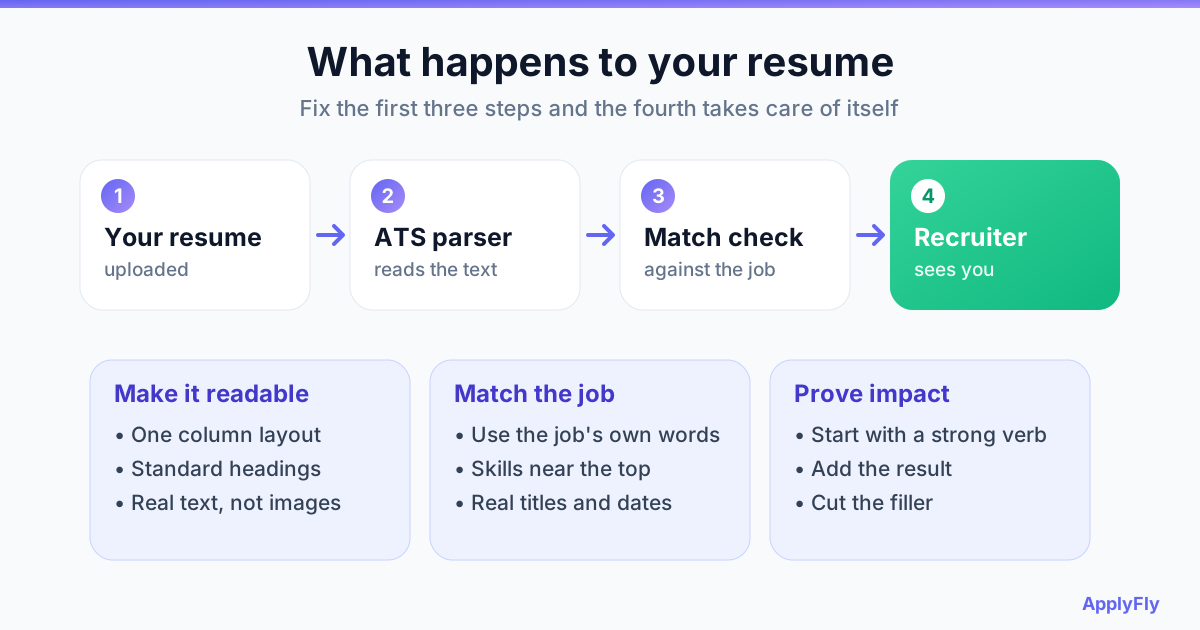
An applicant tracking system, or ATS, is the software companies use to collect, organise and search applications. It is worth understanding honestly, because there is a lot of nonsense about it. Most systems do not hand you a secret score and auto-reject you. What they do is parse your resume into fields (name, titles, dates, skills) and let recruiters search and filter those fields. If your resume parses badly or does not contain the words a recruiter searches for, you become hard to find.
So beating the ATS is really about two things: being readable and matching the job. Here are nine fixes.
Fixes for readability
1. Use a simple, one-column layout
Multi-column layouts, text boxes and tables can scramble the reading order when a system extracts the text. A clean single column is the safest choice and also reads well for humans.
2. Use standard section headings
Call sections Experience, Education and Skills. Creative headings like My Journey or What I Bring are harder for software to map to the right field.
3. Keep text as real text
Do not put your contact details or skills inside images, icons or the page header and footer. Use a normal text file format such as a standard PDF exported from a text editor, or a .docx, and make sure you can select and copy the words.
4. Use real job titles and clear dates
Write the title you held, the company name, and dates in a consistent format such as Jan 2023 – Mar 2025. If your internal title was unusual, add the standard equivalent in brackets.
Fixes for matching the job
5. Mirror the job description's own words
If the posting says Kubernetes, stakeholder management or A/B testing, and you have done it, use those exact terms. Recruiters search with the words in the posting. Only include what is true for you.
6. Put your strongest skills near the top
A short summary and a skills block near the top tell both the software and the person skimming what you are about. Put the skills the job asks for first.
7. Spell out abbreviations once
Write Search Engine Optimization (SEO) the first time, then use the short form. This catches searches for either version.
Fixes for impact
8. Start bullets with a strong verb and end with a result
- •Weak: Responsible for handling customer emails.
- •Stronger: Resolved customer emails daily and cut average response time by building reusable reply templates.
- •Use real numbers only where you actually have them. An honest, specific result beats an invented percentage.
9. Tailor the resume for each job
This is the one that matters most and the one people skip because it is slow. Re-ordering bullets and adjusting keywords for each job takes time, which is why many job seekers use a tool to do it. [ApplyFly](/features) gives each job an AI ATS score before you apply, shows what is missing, and tailors your resume per job so the match is real.
Think of the ATS as a search engine for recruiters. You are not tricking it, you are making yourself easy to find for the right searches.
A 60-second self check
- •Can you select and copy every word in your PDF?
- •Does it read correctly if you paste it into a plain text file?
- •Are your top five skills the same words the job posting uses?
- •Does each bullet show what you did and what changed because of it?
- •Is this version tailored to this job, not just your last one?
See your ATS score before you apply
Upload your resume, check it against a real job description, and get specific fixes in seconds.
Check My Resume FreeFree trial · No credit card required
Frequently asked questions
Does the ATS automatically reject resumes?
Usually not on its own. Most systems parse and organise applications, and recruiters search and filter them. Some employers add knockout questions such as work authorization, which can filter applicants. A resume that parses poorly or lacks the right keywords is simply harder to find.
Is a PDF or a Word file better for ATS?
Both usually work if the file contains real text. A PDF exported from a text editor is generally safe. Avoid scanned images or files where the text cannot be selected. If the posting asks for a specific format, follow it.
Should I copy keywords from the job description into my resume?
Use the job's own terms where they accurately describe your experience. Do not add skills you do not have, and do not hide keywords in white text. Both can backfire in screening and in interviews.
Do I need a different resume for every job?
You need a strong master resume and a tailored version for each role you really want. Tailoring does not mean rewriting everything. It means re-ordering and adjusting the parts that match the job.