Nobody can honestly promise you a job in 30 days. Hiring timelines depend on the company, the role and the season, and a lot of that is out of your hands. What is in your hands is how many good applications you send, how well each one matches the job, and whether you follow up with a human afterwards. Those three things decide how quickly a search moves.
This plan turns them into a four-week routine. It is built for people who are tired of sending applications into silence and want a clear thing to do every day.
Week 1: build one strong master resume and a target list. Week 2: apply every day to roles you genuinely fit, tailoring each one. Week 3: follow up with people and learn from replies. Week 4: prepare for the calls you earned and keep the pipeline full.
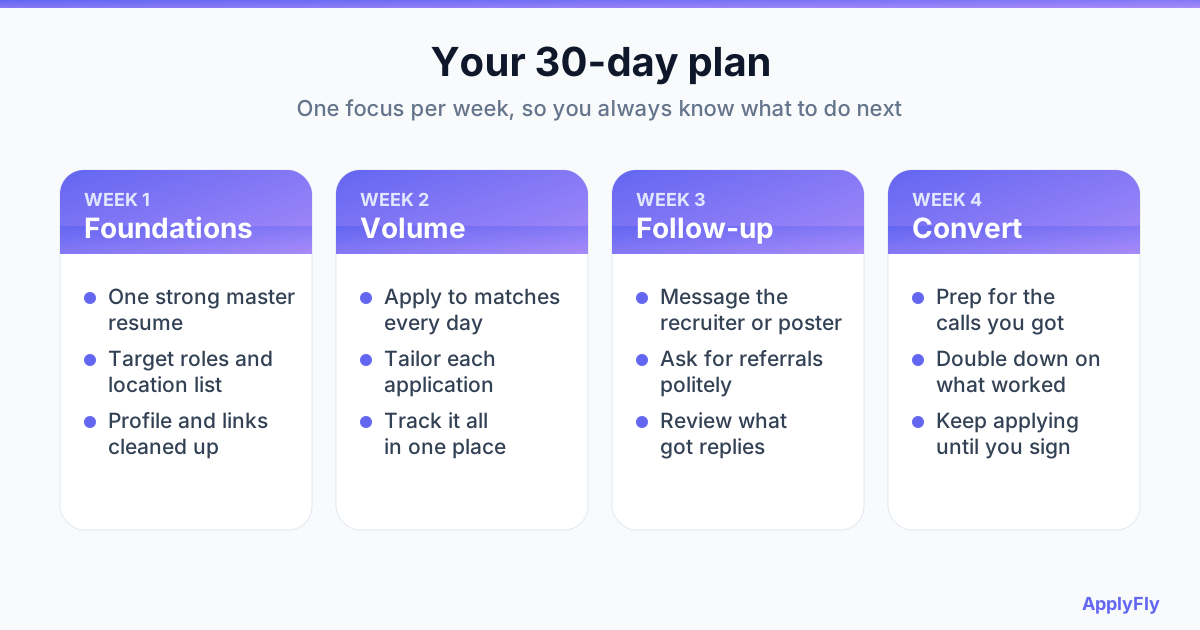
Week 1: Foundations (days 1–7)
Most slow searches are slow because of weak foundations, not too few applications. Spend this week fixing the things every application will rely on.
- •Write one master resume. One clean page or two, standard headings, real text (no images or fancy columns), and your strongest results near the top. See our guide to beating the ATS.
- •Pick your targets. Choose one or two job titles, a location or remote preference, and a seniority level. A vague search produces vague results.
- •Clean up your LinkedIn profile. Match your headline to the roles you want, make your recent experience consistent with your resume, and turn on the setting that tells recruiters you are open to work.
- •Set up job alerts. Fresh postings get the most attention early, so you want to hear about them quickly.
- •Create a simple tracker. A spreadsheet is enough: company, role, date applied, link, status, next step.
Week 2: Volume with quality (days 8–14)
Now you apply every day. The rule is simple: apply to roles you actually fit, and tailor each application to the job. Sending the same resume to everything is the fastest way to get ignored. We cover the numbers in how many jobs to apply to per day.
- •Shortlist matches in one sitting, then apply in one focused batch instead of dipping in all day.
- •Mirror the job description's own words for skills and tools, wherever it is true for you.
- •Answer screening questions honestly and consistently. These are often checked against your resume.
- •Log every application the moment you send it.
If tailoring every resume by hand is what slows you down, this is the step to automate. A tool like [ApplyFly](/features) reads each job description, scores your resume against it with an ATS check, tailors your resume per job and applies for you, so the daily batch takes minutes instead of hours.
Week 3: Follow-up (days 15–21)
Applications get you in the pile. People get you out of it. This week, put a human behind your best applications.
- •For your top picks, find the recruiter, hiring manager or the person who posted the job, and send a short, specific note. Say which role you applied for and one reason you fit.
- •Ask past colleagues and classmates whether they know someone at the company. A referral request that is polite and easy to say yes to is worth more than another blind application.
- •Look at your tracker. Which roles or companies replied? Which resume version did you use? Do more of what is working.
Week 4: Convert (days 22–30)
- •Prepare for every call you get. Re-read the job description, prepare three stories that show results, and write your own questions for the interviewer.
- •Keep applying. Do not stop when the first call appears. Pipelines dry up quickly if you pause.
- •Follow up after every interview within a day, with a short thank-you that repeats one thing you can do for them.
- •Compare offers calmly. If you have more than one, ask for the details in writing and take a day to decide.
What speeds a search up, and what slows it down
| Speeds it up | Slows it down |
|---|---|
| Clear target roles | Applying to anything that looks vaguely right |
| A tailored resume per job | One generic resume for everything |
| Daily, consistent applications | Binge applying one weekend, then nothing |
| Messaging real people | Only applying through portals |
| A tracker you review weekly | Forgetting where you applied |
Make the daily batch take minutes
ApplyFly scores your resume against each job, tailors it, and applies for you, so you can spend your time on follow-up and interviews.
Try ApplyFly FreeFree trial · No credit card required
Frequently asked questions
Can you really get a job in 30 days?
Some people do, but nobody can promise it. Timelines depend on your field, location and the market. This plan focuses on what you can control: quality applications every day, tailoring and follow-up, which are the habits that shorten a search.
How many applications should I send in the first month?
There is no magic number. A steady daily routine of well-matched applications beats a burst of random ones. See our guide on how many jobs to apply to per day for a practical starting range.
Is it better to apply early or tailor my resume first?
Both matter. Applying soon after a job is posted helps, but a tailored application sent a day later usually beats a generic one sent instantly. Tools that tailor automatically let you do both.
What if I am not getting any replies by week three?
Treat it as feedback. Check that your resume reads cleanly, that you are applying to roles you genuinely fit, and that you are adding keywords the job uses. Then add more follow-up with real people.