Auto-apply tools promise to send applications for you while you do something else. Some job seekers love them. Others say they got nothing from them, or that they were ignored by every company. Both experiences are real, and the difference usually comes down to how the tool is used, not whether automation is good or bad.
Auto-apply is worth it when it saves you the slow parts (tailoring and form filling) while you keep control of targeting and quality. It hurts when it blasts the same resume at roles you do not fit.
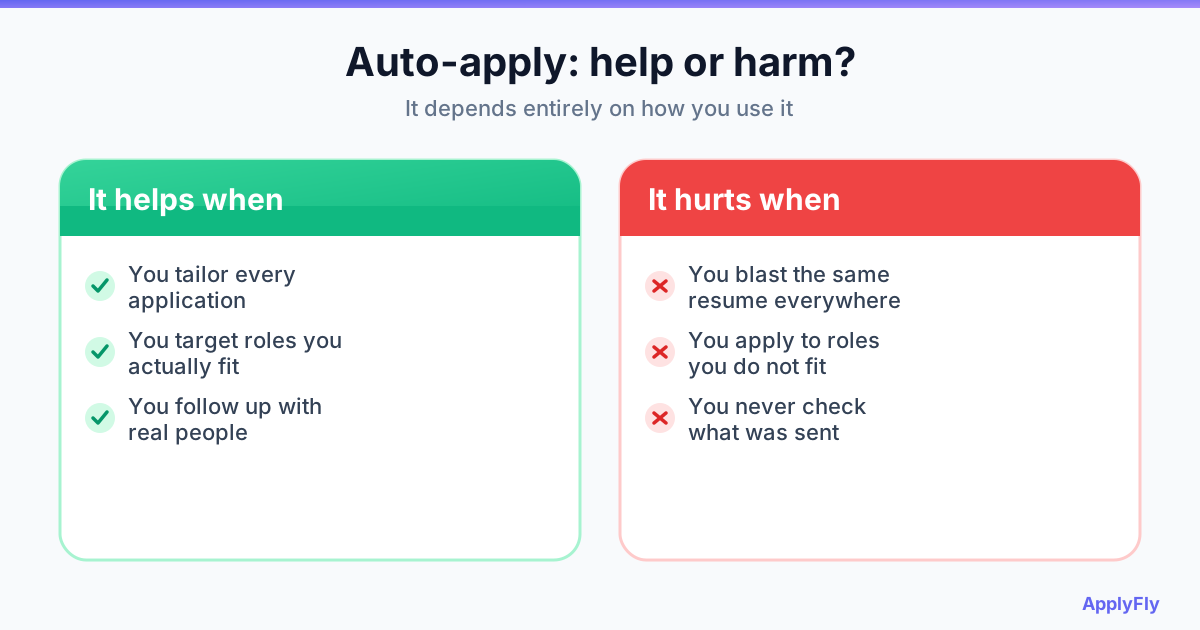
When auto-apply helps
- •You are applying to many similar roles. Filling in the same details again and again is a good job for software.
- •Each application is tailored. A resume adjusted to the job's keywords gets found more easily than a generic one.
- •You have a fit filter. A tool that scores each job against your resume and skips poor matches keeps your volume useful.
- •You use the time you save. Messaging recruiters, preparing for interviews and networking are where the saved hours pay off.
- •You review what was sent. Spot checks catch wrong answers or the wrong resume early.
When auto-apply hurts
- •The same resume goes to every job. Without tailoring, you are just sending more of the same.
- •It applies to roles you do not fit. Mismatched applications waste your effort and can leave a poor impression with companies you might want later.
- •Screening answers are generic or wrong. Questions about experience and authorization are checked, and wrong answers can disqualify you.
- •You stop paying attention. Nobody is following up, so strong matches go cold.
- •It only covers one platform. If you can only reach one job board, you miss roles posted directly on company applicant systems.
What to check before you pick a tool
| Question | Why it matters |
|---|---|
| Does it tailor the resume for each job? | A generic resume everywhere is the main reason auto-apply gets ignored. |
| Does it check fit before it applies? | A quality gate keeps volume from turning into noise. |
| Which platforms does it really submit to? | LinkedIn alone is limited. Many employers use Greenhouse, Lever, Workday and similar systems. |
| Can you see and control what it sends? | You should be able to review answers, resumes and history. |
| Is the pricing clear? | Check what is included per day and what costs extra. |
For a detailed comparison, see our ranking of auto-apply tools and the list of LazyApply alternatives.
How ApplyFly approaches it
[ApplyFly](/features) is built around those checks: it scores your resume against each job description with an AI ATS check, tailors the resume and cover letter per job, and applies on LinkedIn and supported ATS platforms. You choose the roles and review what was sent. Automation is only as good as the targeting behind it, so the controls are yours.
A safe way to try it
- •Start with a small daily number and review every application it sends for the first few days.
- •Set a strict role filter: titles, location and experience level.
- •Track replies by role type and adjust the filter, not just the volume.
- •Keep following up with people on your best matches yourself.
Try auto-apply with the safeguards on
Start free, set your roles, and see the ATS score for every job before anything is sent.
Try ApplyFly FreeFree trial · No credit card required
Frequently asked questions
Does auto-apply actually get interviews?
It can, when it is paired with good targeting and per-job tailoring. Results vary by field, location and market, and no tool can guarantee interviews. Treat it as a way to send more good applications, not a replacement for follow-up.
Will companies reject me for using a bot?
Companies care about the quality and fit of the application they receive. Generic, mismatched applications get ignored whether they were sent by hand or by a tool. Check each platform's terms of use before you automate.
Is auto-apply safe for my accounts?
Platforms have rules about automated activity. Use a tool that is transparent about how it works, keep your volume reasonable, and read the terms of the sites you apply on.
Should I still tailor my resume if I use auto-apply?
Yes, or use a tool that does it for you. Tailoring is the biggest factor in whether an automated application gets noticed.